
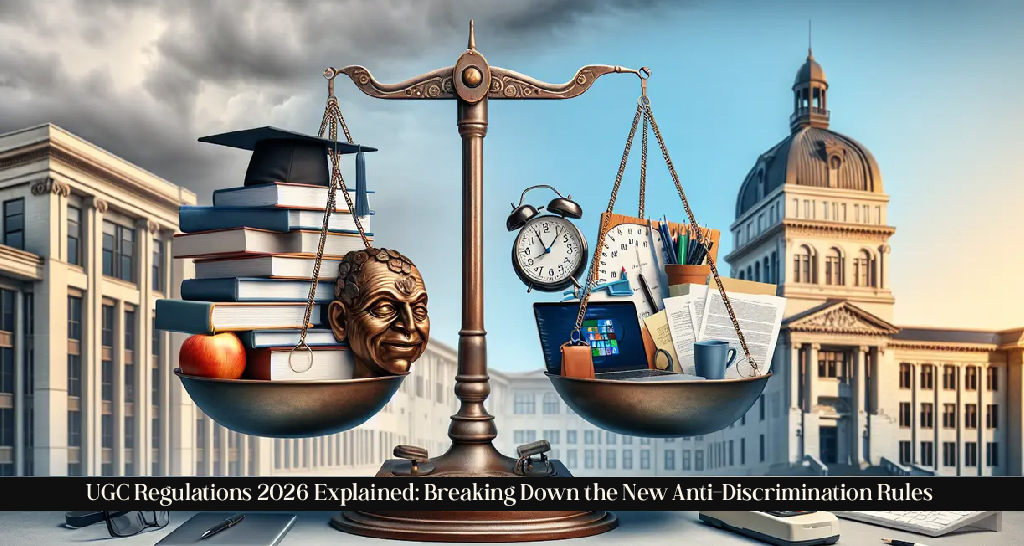
The new UGC regulations, introduced in January 2026 have triggered a major backlash among the upper caste communities. This fresh regulation focuses on making India’s campuses safer and more inclusive by removing discrimination across universities and colleges. This new change comes against the increasing number of caste-linked complaints.
UGC, the autonomous body under the Ministry of Education, introduced the University Grants Commission Regulations, 2026. This new rule will apply to all higher education institutions across the country. The new rules will replace the earlier 2012 rules. The new guidance will be legally binding on all UGC-recognised universities and colleges, instead of being the advisory framework of the past.
Key Highlights of UGC New Regulations
The key focus of this new regulation is the comprehensive definition of discrimination, including unfair treatment based on caste, tribes, religion, gender, race, disability or place of birth. Under these rules, direct and indirect forms of discrimination are covered.
As per the rules, it will be mandatory for all colleges and universities to set up an Equal Opportunity Centre, which will file complaints, supervise discrimination-related issues and promote inclusive practices. Institutions also need to create a proper system to receive, record and resolve complaints with continuous monitoring and reporting.
The rules include OBC students and ensure their representation on the equality committees of institutions. The purpose is clear: to grow inclusivity and equality within the academic environment.
Further, strict action has been stated for direct or indirect acts of discrimination. UGC has also noted that discrimination against SC/ST and OBC students will be taken as a crime, and strict action will be taken against it.
Colleges and universities that fail to follow these regulations may face penalties like denial of approval, exclusion from the UGC scheme or loss of recognition.
Two contrasting narratives have emerged for this new guideline. On one side, the government and UGC favour these rules, claiming to make colleges and other institutions discrimination-free and safer for all students. As the statement released by the government, strict regulations are required to ensure every student can study with dignity, respect and security.
On the other side, a section of society is feeling anxious about these new rules. They have questions about whether being from the savarna community is an offence in itself. Their concern is that these new legal rules will create the circumstances under which they might be assumed guilty with little to no opportunities to prove their innocence. According to them, the new regulation, introduced to eliminate fear, has instead created a new kind of fear.
At the centre of the controversy are concerns raised from the wrong information and misunderstandings among people. Ministry sources have assured the people of the country that the new regulations will not be misused in any situation, and misinformation is being spread.
Today, social media is flooded with opinions, arguments, and accusations. While the government is striving to ensure commonpeople, social media discussions have intensifedwith the hashtag #RollbackUGC is trending. But to actually understand this controversy, let’s go back and look at the UGC regulations, their purpose and introduction.
The UGC regulations were formally intrdouced on January 2026; these rules will be implemented under the framework of the New Education Policy. After getting multiple reports of discrimination in campus over the years, the government found that existing rules were not encouraging.
As per the new guideline, if a student feels they have been treated unfairly, they can file a complaint online or through a helpline. The institution need to complete a fully inquiry under 15-30 days.
The focus of the controversy is the changes introduced in the new framework. In the previous regulations, there was a provision that if someone made a false allegation of discrimination, the complainant could also face punishment. This rule was a safeguard for the prevention of misuse of the law. This safeguard has been removed in the new regulations; this is the main fear of general category students.
According to experts, the key reason behind this step is to make sure that the genuine victims are not discouraged from reporting about the incidents due to the fear of punishment. While general category students are worried that if complaints do not face any consequences despite false complaints, the law will be misused.
Another controversial aspect is the Equity Squads. For goevernemnt, these squads are protective teams that will monitor sensitive areas of campus for assureing the safety of students. These squads will do patrolling in hostels, sitting areas, canteens and across the campus.
For students, they are a kind of continuous surveillance. Students from the general category are afraid that indirect discrimination could lead to normal day-to-day behaviour being misinterpreted and reported wrongly.
Nationwide Protests
Earlier, what began as digital arguments has spread onto university campuses – student groups and several faculty members staged demonstrations in different cities, asking for better protection and more public consultation.
Students from Lucknow University came on strets against the UGC’s new regulations.
Some upper-caste students held a protest before the UGC headquarters, saying the new regulations will create chains across the institutions.