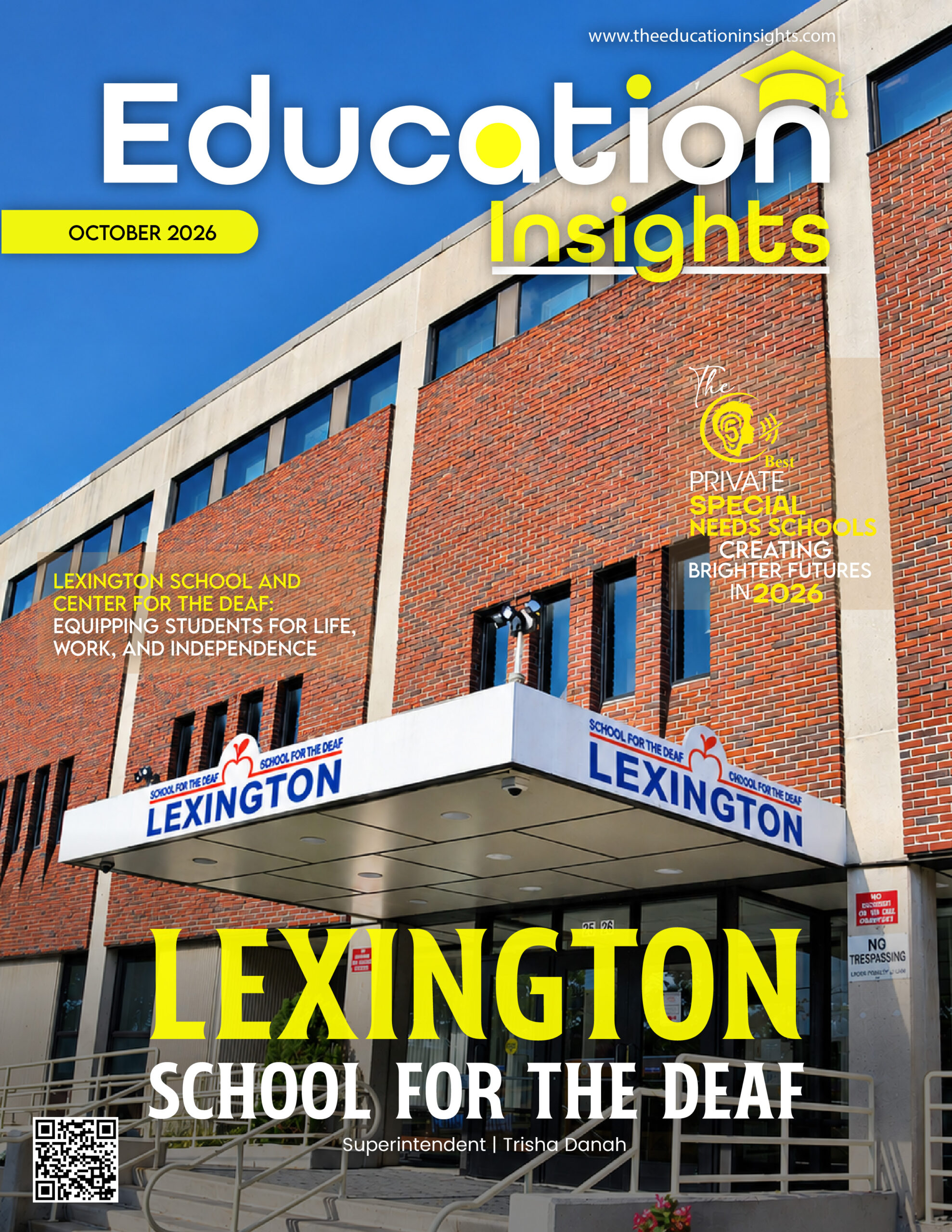

Founded in 1864, Lexington School and Center for the Deaf has evolved alongside the field of Deaf Education. Over the years, one thing has remained constant: the school’s commitment to meeting Deaf children where they are and preparing them for where they want to go.
Today, that commitment is grounded in creating a language-rich, accessible educational environment where students can learn, communicate, build relationships, and develop a strong sense of identity. The school recognizes that Deaf students are not a monolithic group. They have different language experiences, cultures, family backgrounds, academic profiles, and additional needs. It’s the school’s responsibility to understand the whole child rather than asking the child to fit into a predetermined educational model.
Lexington was founded by Isaac and Hannah Rosenfeld, a family seeking meaningful educational opportunities for their Deaf child. What began as a small effort in the Rosenfelds’ home, with just six Deaf children, grew into what is now Lexington School and Center for the Deaf. From the beginning, the School’s story has been closely connected to the needs of Deaf children and their families, a connection that still continues to shape its educational mission today.
Development of the Whole Student
Lexington School and Center for the Deaf’s whole-student philosophy cannot be separated into individual departments. Academic achievement is intertwined with language and social-emotional development. Physical and mental wellness influence a student’s readiness to learn. In addition, identity and belonging shape students’ confidence and engagement.
That is why Lexington uses an interdisciplinary approach. Teachers work alongside counselors, behavioral specialists, speech-language professionals, occupational and physical therapists, audiologists, nurses, transition professionals, and other specialists. Lexington’s mental health services include individual counseling, therapeutic and psychoeducational groups, family support, and consultation with instructional staff.
“Our goal is not simply to provide multiple services around a child. It is to ensure those services are aligned around the child. When our professionals communicate, share data, understand the student’s language and communication profile, and work toward common outcomes, we are much better positioned to support meaningful growth,” explains Trisha Danah, Superintendent of Lexington School and Center for the Deaf.
Ensuring Access to Education and Languages
When a child joins Lexington, the school’s priorities are to ensure proper access to education and languages and to provide a sense of belonging and understanding.
“Before we can determine how to teach a student effectively, we need to understand who the student is. We look at language and communication, academic performance, social-emotional development, physical and developmental needs, prior educational experiences, interests, strengths, and family priorities,” explains Trisha.
Language access is of utmost importance. While children arrive with strong language foundations, some may have experienced limited access to language or an inconsistent communication environment.
“Just as importantly, we want students to feel that Lexington is a place where they belong. A child should quickly begin to understand: There are people here who communicate with me. There are people like me here. I am understood here. I can succeed here,” adds Trisha. “From that foundation, the educational team can establish appropriate academic, language, social-emotional, and developmental goals.”
Identifying a Child’s Strengths
The school starts from an asset-based perspective. According to Trisha, most of the time students with disabilities are introduced through what they cannot do. However, at Lexington, teachers ask a different set of questions: What can this student do? How does this student learn? What motivates them? Where do they demonstrate confidence? What communication strategies work?
Teachers and specialists use formal assessments, classroom data, observations, student work, IEP information, family input, and direct interaction with the student to develop that picture.
Teachers then use those strengths as an entry point for instruction. A student’s interests can increase engagement. Visual strengths can support conceptual understanding. Strong ASL skills can become a foundation for developing English literacy. Social strengths can create opportunities for collaborative learning and leadership.
A Safe Space
Within Lexington’s SOAR values (Safe, Open-Minded, Accountable, and Respectful), its commitment to language accessibility sets a high standard for the entire community.
Belonging goes beyond physical safety. Students need emotional and linguistic safety. They need direct access to communication, meaningful opportunities to build relationships with peers and adults, and the chance to see Deaf people represented in the roles and professions they may one day pursue. Representation is therefore an essential part of the Lexington experience. The School has made Deaf leadership an important part of its history. Frank Bowe became Lexington’s first Deaf superintendent in 2003, serving for a year. Donald Galloway became its second Deaf superintendent and served from 2013 to 2019. In 2026, Trisha Danah became Lexington’s first Deaf woman superintendent. Beyond the superintendent’s office, Deaf professionals have also served as principals, directors, teachers, and staff members across the School. One particularly remarkable example is Jane Moran, who recently retired after more than 50 years at Lexington. Her journey took her from student to teacher to administrator, reflecting the kind of long-term connection between individuals and the School that Lexington strives to cultivate.
Lexington also employs Deaf teachers and staff. They are front-line role models for students. When young people have the opportunity to see Deaf adults succeeding in careers and positions that interest them, they can begin to envision those possibilities for themselves. Representation at Lexington, however, is not limited to Deaf identity. The School equally values racial and cultural identities, recognizing that students’ experiences and perspectives are shaped by many dimensions of who they are.
Early Language and Communication Support is Critical
The earliest years of a child’s life are foundational for language, cognitive development, social-emotional growth, and future academic learning. For Deaf and Hard of Hearing children, timely access to a fully accessible language and communication environment is especially important.
The School’s Ready to Learn program serves infants and toddlers from birth to age three through a family-centered approach. While language and communication are at its core, the program also supports gross and fine motor development, social-emotional growth, self-help skills, and preschool readiness. Families can pursue spoken language, sign language, or both, with support available in English, Spanish, ASL, and, through interpreting services, other home languages.
Families are essential partners in this journey. Early intervention providers and centers should support families by providing comprehensive information about the range of available pathways, allowing families to make informed decisions based on their individual needs and priorities. Lexington seeks to provide families with information, resources, coaching, and meaningful opportunities to communicate with their children. The goal is to empower families to make informed choices while ensuring that their children have consistent and accessible opportunities to develop language.
That support extends beyond the child and the classroom. Lexington creates opportunities for families to connect, build friendships, and help ensure their children have access to peers outside the School environment. The School also encourages families to learn ASL, recognizing its importance as an accessible language for Deaf children and as a way for families to build meaningful, lasting communication with them.
In addition to the Ready to Learn program, Lexington offers a Deaf Mentor Program for families with Deaf children between the ages of 0-5. A Deaf Mentor is a trained, culturally Deaf or hard of hearing adult who guides families and children with hearing loss to build strong communication skills and cultural connections. The philosophy is very simple yet far-reaching: when children have access to language early, they gain more than communication. They gain a foundation for literacy, relationships, emotional development, self-advocacy, and lifelong learning.
Priorities for 2026 and Beyond
Lexington’s direction is guided by this year’s theme: Belong · Connect · SOAR. It reflects a broader purpose—to foster a language-rich education that connects and empowers Deaf students so they can soar into their futures. For the leadership team, this vision is captured in the sub-theme “Connected by Purpose, Centered on Students.”
Lexington is also strengthening the alignment between curriculum, assessment, instruction, intervention, and professional learning. The school wants educators to have meaningful data and the professional capacity to use that data to make instructional decisions.
Third, Lexington is continuing to strengthen student belonging, mental health, safety, and school culture. Students learn best when they feel safe, respected, valued, and connected to their community.
Fourth, it is strengthening college, career, transition, and independent-living pathways. Lexington’s responsibility does not end at graduation. Instead, the school must prepare students for meaningful adult lives and give them the skills to advocate for communication access and navigate systems independently.
Fifth, the school is strengthening partnerships with families. Families should understand their child’s strengths, progress, educational goals, and options and feel that they are meaningful partners in the educational process.
Finally, Lexington is investing in its people and organizational culture. Strong student outcomes require strong educators, specialists, support professionals, and leaders who understand their purpose and recognize how their individual work connects to the larger mission.
“Lexington has more than 160 years of history behind us. Our responsibility now is to determine what the next generation of Lexington will become. We can honor our history without being limited by it. We can preserve what works, challenge what needs to evolve, and remain responsive to the changing landscape of Deaf Education,” concludes Trisha.