
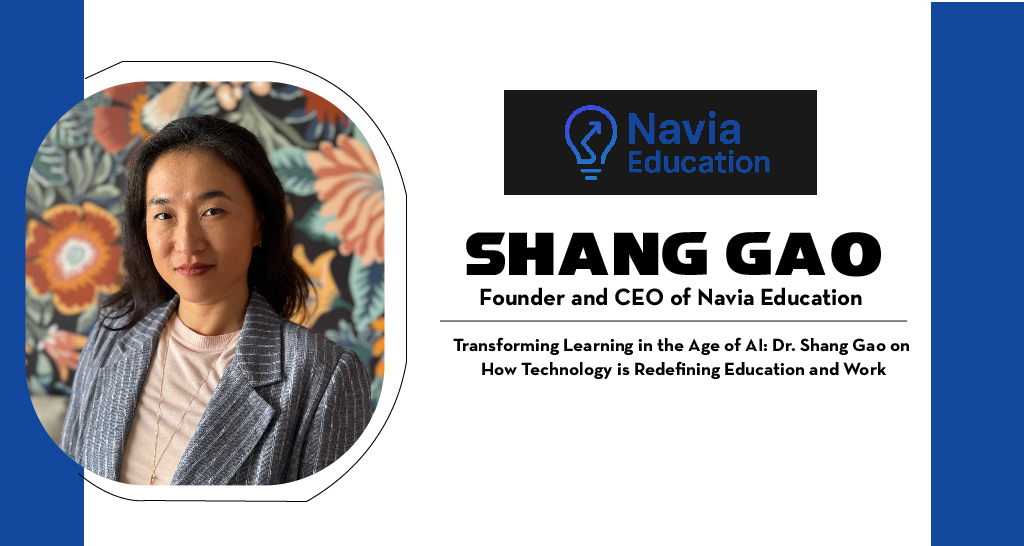
Dr. Shang Gao is the Founder and CEO of Navia Education, a future-focused company dedicated to enable 1 million people by bridging learning, technology, and employability. With over 15 years of experience across the World Bank, Asian Development Bank, and Amazon Web Services, she has led education reforms, digital skills, and workforce development programs across Asia-Pacific. A development economist turned tech leader, Dr. Gao brings a rare combination of policy insight and innovation expertise to her mission of making education more inclusive, adaptive, and human centered.
From Development to Tech: A Journey of Impact
Dr. Gao began her career as an Education Economist at the World Bank, working across Southeast Asia and Sub Saharan Africa, covering primary and higher education sectors. In 2017, she made a pivotal shift from global development to the technology sector, recognizing how profoundly technology was transforming teaching and learning, and that achieving large-scale, sustainable impact required education policy and technological innovation to move in tandem.
This conviction led her to Amazon Web Services (AWS), where she led regional teams to create and scale education and skills programs that reimagined learning for the digital era, reaching millions each year with in-demand technology skills. Dr. Gao believes the future of education and workforce development will be defined by how responsibly and inclusively we harness AI to empower learners. By bridging development insights with private-sector innovation, she continues to advance opportunities for underrepresented communities and build systems that make learning more equitable and future-ready.
Cross-Cultural Leadership Lessons
Effective leadership transcends geography. It is grounded in service, vision, and the ability to unite people across boundaries. Throughout her career, Dr. Gao has led teams and partnerships spanning multiple countries and cultures. While contexts may differ, people everywhere aspire to the same fundamentals: respect, fairness, recognition, and purpose.
For her, cultural agility means more than adapting to differences; it is about amplifying shared purpose and building trust through clarity, empathy, and collaboration. When people feel understood and valued, they bring their best ideas forward. Dr. Gao believes that when trust and shared direction align, teams can achieve impact far greater than what any one culture or organization could accomplish alone.
Guiding Principles for Leadership
For Dr. Gao, leadership begins with purpose and service. Her lifelong commitment to education and personal growth has shaped a deep sense of responsibility, not just to lead, but to enable others to thrive.
Her guiding principles are rooted in equity, integrity, and impact. These values have shaped every chapter of her career, from expanding access to digital learning to building skills ecosystems that connect talent with opportunity across Asia-Pacific. She believes that leadership is not defined by hierarchy or title, but by the ability to empower others, uphold ethics, and nurture human potential. In her view, the most enduring leaders are those who balance ambition with empathy and those who create environments where people can grow, innovate, and succeed together.
Effective Leadership in a Global Context
Leading diverse teams across countries and cultures requires more than management; it requires understanding, trust, and shared purpose. For Dr. Gao, effective leadership begins with alignment, ensuring that people, no matter where they are, see themselves as part of something larger. Trust grows from there, and it grows through transparency, consistency, and mutual respect.
Equally essential is empathy. Having led multicultural teams across Asia and beyond, Dr. Gao has learned that motivation and success mean different things to different people. A good leader listens deeply, adapts communication to context, and creates space for others to be seen and heard. She believes that the most impactful leaders combine cultural agility, courage, and inclusivity; leaders who challenge silos, bridge differences, and unite people behind a shared vision. In today’s interconnected world, such leadership is what sustains collaboration and drives collective action toward a common goal: building a future where technology and education advance together for the greater good.
Navigating Workforce Transformation
Driving workforce transformation requires more than technology, it demands a deep understanding of how people, institutions, and systems evolve together. Throughout her career, Dr. Gao has worked closely with governments, universities, and industries to design large scale initiatives that align national priorities with workforce needs. She believes the key lies in listening first: understanding the aspirations, constraints, and timelines of education and government leaders before introducing change. Transformation, she notes, works best when it builds on what already exists rather than imposing something new. In practice, that means identifying early champions, empowering them with resources and success stories, and creating an ecosystem that connects education with industry. This is to ensure that learning leads to employability and national competitiveness. Just as important is establishing feedback loops to measure progress and inform resource allocation. For Dr. Gao, true transformation happens when policy, technology, and human potential move in harmony. “Change that lasts,” she says, “is built on collaboration, trust, and the shared belief that learning can drive opportunity for all.”
Measuring Impact in Digital Skills Training
For Dr. Gao, impact is not measured only in numbers; it is measured in empowerment. During her time at AWS, she helped to create and scale the AWS Skills to Jobs Tech Alliance model, a global coalition of governments, universities, and employers united by a common goal: closing the digital skills gap and connecting learning directly to employment outcomes. The model focuses on aligning education with the real needs of the labor market, integrating industry expertise into curricula, equipping educators with emerging tech skills, and helping learners gain credentials that lead to meaningful work. “Impact,” she explains, “means when a graduate doesn’t just earn a certificate, but lands a job, builds a career, and uplifts their community.”
Under this model, social and business impact go hand in hand. Each learner trained represents both individual empowerment and economic value creation, a reflection of how inclusive skilling fuels innovation and growth. Through partnerships with public entities such as governments and employers across Asia-Pacific, Dr. Gao and her team have helped millions gain access to future ready skills, proving that when education and technology align, transformation scales exponentially.
Impact of AI and Machine Learning
Artificial intelligence (AI) and machine learning (ML) are transforming how people learn, teach, and prepare for the future of work. These technologies do not replace human intelligence but amplify it. AI can make learning more personalized and participatory: tailoring content to each learner’s needs while freeing educators to focus on mentorship, creativity, and critical thinking.
At the same time, AI and ML are reshaping job readiness. Every learner, regardless of discipline, now needs to understand how AI influences their field and how to use it responsibly. As Dr. Gao notes, “The goal is not for machines to think for us, but to help us think better.” Through Navia Education, she helps individuals and organizations to integrate AI and emerging technologies into education and workforce systems to together cultivate a generation of adaptable, creative, and ethically grounded professionals ready to thrive in an AI-augmented world.
Reimaging Education-to-Employment Pathways
It starts with clarity of purpose. Learners must define what employment truly means to them: whether working within an organization, building their own enterprise, or contributing through social innovation and gig platforms. “Having a clear sense of direction is half the work done,” she says. The other half lies in connecting education with experience. The traditional linear model — study first, work later — is giving way to blended pathways that merge classroom learning with real-world problem-solving. Universities, industries, and governments must collaborate as networks, not pipelines, co-designing curricula, credentials, and experiences that reflect evolving market needs and values.
Through initiatives like the AWS Skills to Jobs Tech Alliance and now Navia Education, Dr. Gao continues to champion partnerships that align skills with opportunity. In her view, the future belongs to lifelong learners — individuals who continuously upskill, reskill, and adapt in response to technological and societal change.
Future-Proofing Skills: A Balanced Approach
To thrive in the next decade, learners will need a balanced portfolio of skills: blending cognitive, technical, and human capabilities. Core competencies such as critical thinking, communication, and creative problem-solving remain foundational. Yet, technical fluency is increasingly indispensable: cloud literacy, digital fluency, and AI literacy now form the new baseline for employability in the digital economy.
Equally vital are human-centered skills, such as creativity, empathy, collaboration, and emotional intelligence. These uniquely human abilities will distinguish individuals in an age of automation. “The most successful professionals,” Dr. Gao explains, “will be those who can bridge human insight with digital capability.”
Finally, ethical and sustainability-oriented skills will define the professional ethos of the next generation. Learners must understand how to use technology responsibly, protect privacy, and innovate for social and environmental good. In Dr. Gao’s view, the future of education is not simply about producing graduates; it is about developing adaptable, ethical, and purpose-driven citizens who can shape a better world.