

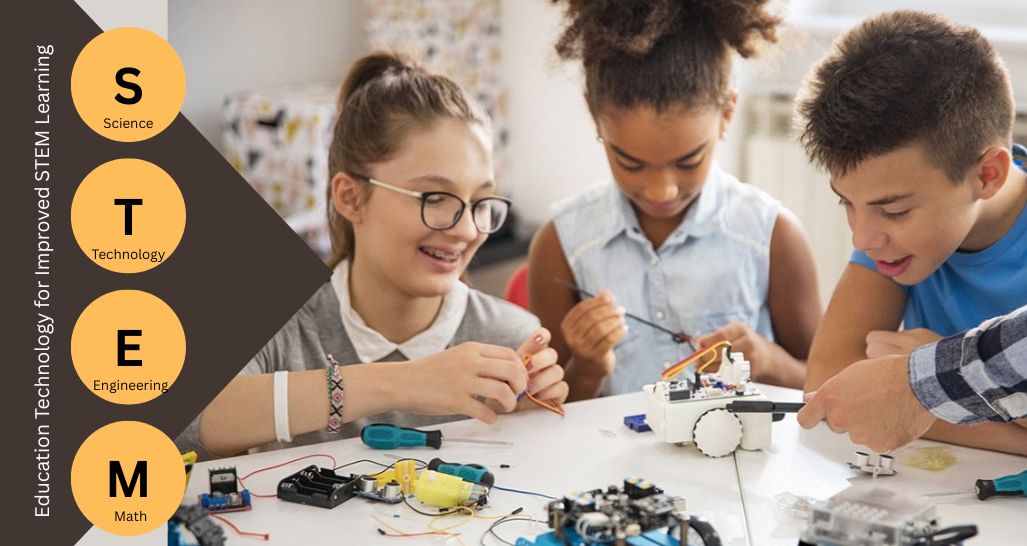
Educational institutions all over the world are swiftly changing how they learn and teach STEM (science, technology, engineering, and math) courses. This is because schools are using more technology (EdTech). Schools are employing digital tools, AI, and fun platforms to help students learn, understand, and get involved. In the last several years, EdTech has played a huge role in revolutionising STEM education by making difficult concepts easier to grasp and allowing students to take charge of their own learning.
The introduction of AI into classrooms exemplifies one of the most revolutionary changes in STEM education. Artificial intelligence systems can study students’ learning styles, track their progress, and tailor lessons to meet the needs of each student. Not all these strategies use the same approach to teaching every kid. Another possibility to think about is creating personalised learning plans for each student. If a student is struggling with a topic on the platform, for example, with physics or mathematics, they will be able to get more practice problems, explanations, and comments on the subject. Students’ understanding of difficult concepts is enhanced using this tailored approach, leading to greater learning outcomes.
Another significant development in the field of science, technology, engineering, and mathematics (STEM) education is the use of immersive technologies like augmented reality and virtual reality. Students can now visualize and investigate scientific concepts in ways that were previously unimaginable using standard textbooks. This is made possible by technological advancements that have enabled the creation of interactive environments. Specifically, this is because these textbooks do not have any interactive elements. Students could examine the solar system, learn about the structure of molecules, and even practise engineering design simulations while they are in a classroom that is conducted online. By providing students with visual and interactive representations of abstract concepts, these immersive experiences make learning more interesting and accessible. This is because they allow students to learn about abstract concepts.
In the area of STEM education, virtual labs are also becoming a more important part of the picture. Many schools and colleges have problems with their lab equipment, space, and safety regulations. Using virtual lab platforms, students can do experiments in a digital setting, which will fix this problem. Students can undertake things like chemistry experiments, learn about biological processes, or run simulations of engineering models. You may do experiments repeatedly in these digital labs without worrying about accidents or having to buy supplies. This is why students can get hands-on experience even when there are not many physical resources available.
The utilisation of games is yet another trend that allows STEM educators to improve their teaching. Educational sites offer prizes, stages, and challenges to make learning more enjoyable and engaging for children. Students appreciate learning through games because it prevents them from becoming disinterested, compels them to compete with one another, and assists them in finding solutions to difficulties. The puzzles and challenges that are included in certain math apps and coding platforms might assist you in learning how to code and develop your critical thinking skills. In addition to making STEM classrooms more enjoyable for students, these projects also assist children in developing their ability to think effectively and come up with fresh ideas.
A lot of data analytics is also used in contemporary schools as part of their modern education technology. Digital learning platforms can collect information about students. This information can help teachers figure out what their students are lacking. Predictive analytics technology can also help teachers find students who are falling behind early on by showing them where they were at the start of the school year. The teachers can make better choices and make sure that all the kids get the help they need by using this data-driven method.
Education technology is aiding both students and teachers. Digital assessment tools and automated grading systems can quickly grade assignments and quizzes, which saves teachers a lot of time. Teachers can spend less time reviewing papers and more time helping students, leading conversations, and coming up with creative initiatives. A lot of schools are also offering training programs to help teachers learn how to use technology in their classrooms.
Using technology that lets individuals work collaboratively is another crucial aspect of modern STEM education. You may work together on projects, share ideas, and solve problems using online platforms. This is extremely similar to how engineers and scientists work together in the real world, where good communication and teamwork are very important. Students from all over the world can work together on engineering projects, coding challenges, and group experiments, no matter where they are.
Because of the implementation of technology in educational settings, several issues have been recognised as being problematic. There are still many regions of the world that continue to struggle with issues relating to dependable internet connections and access to digital gadgets. If the necessary infrastructure is not readily available, then not all children will be able to take advantage of the technical improvements that have been made. There is concern about the ethical usage of artificial intelligence in educational settings and the privacy of the data of pupils. To safeguard the personal information of students and ensure that technology can augment instruction without taking the place of thoughtful analysis, organisations, including educational institutions, are required to establish unambiguous criteria.