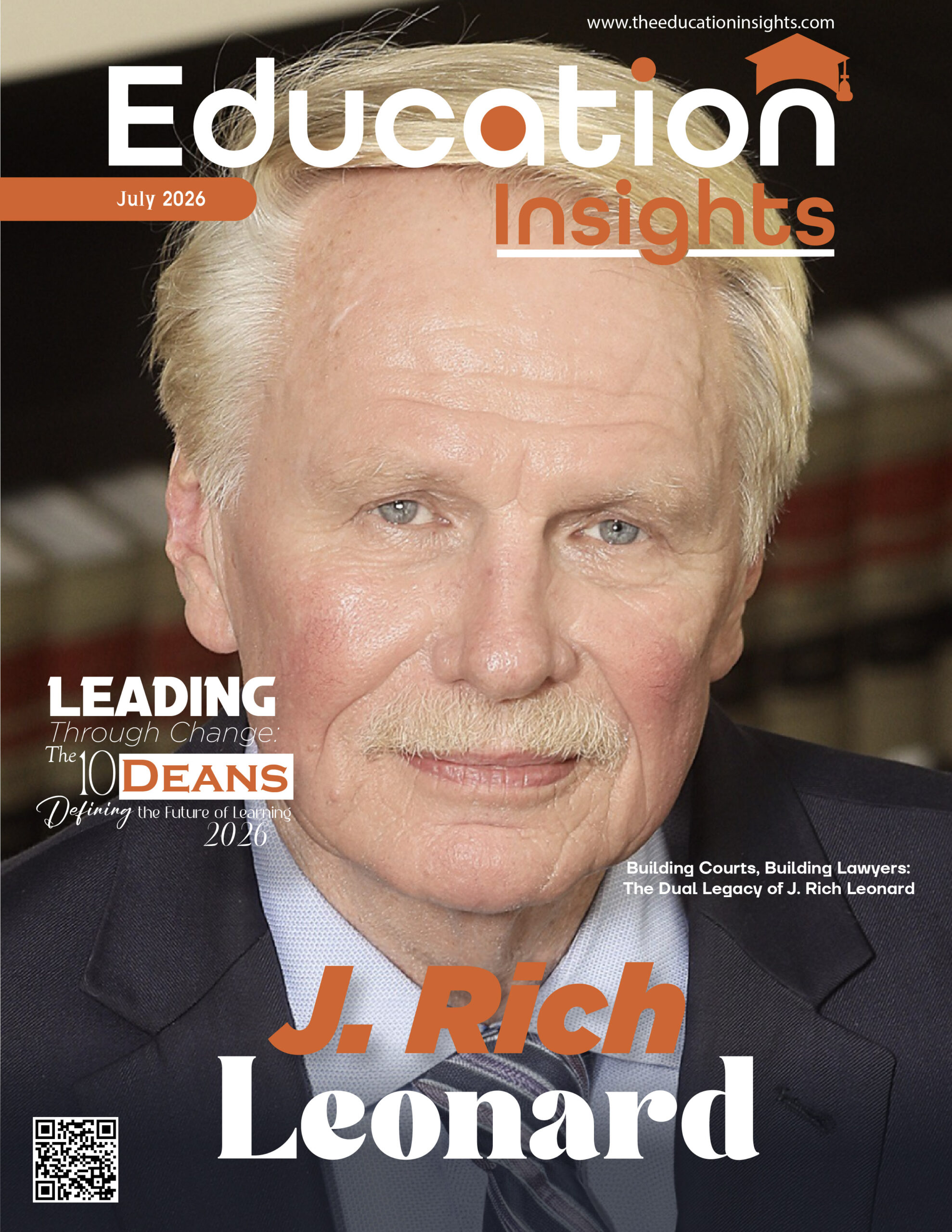

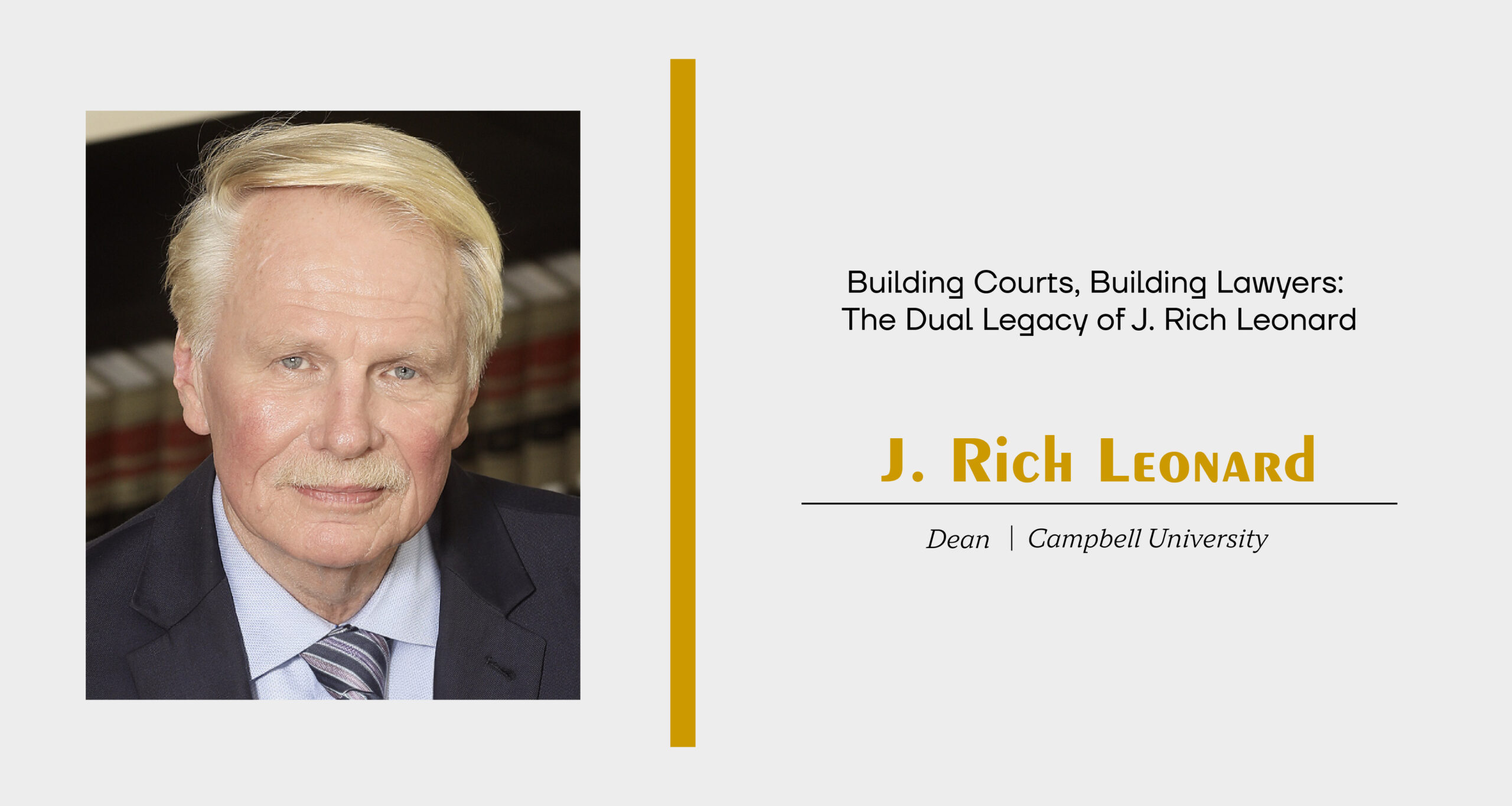
J. Rich Leonard is a legal architect redefining judicial service and legal education by focusing on practical experience. A former United States Bankruptcy Judge for the Eastern District of North Carolina and current Dean of Campbell University’s Norman Adrian Wiggins School of Law, he has built a courtroom-ready curriculum and created global judicial partnerships to help transform law students into practice-ready professionals.
For 40 years, Rich has extended his work abroad, with some 80 trips to Africa to help the U.S. State Department organize the judicial systems in Ghana, Zambia, Tanzania, Namibia, Kenya, and Nigeria. At Campbell Law, he brings a global lens to students through study abroad programs in Ghana and in conjunction with Samford Law School in Cambridge, England, Baylor Law School in St. Andrews, Scotland, and Nottingham Law School in England. In 2023, Rich traveled as a Fulbright Specialist Scholar to Bhutan, where he taught an international comparative bankruptcy course to law students for five weeks.
The Early Years
A native of Welcome, North Carolina, Rich graduated from the University of North Carolina at Chapel Hill in 1971 as a Morehead Scholar. He went on to earn a master’s degree in education from UNC-Chapel Hill in 1973 and a JD from Yale Law School in 1976.
From 1976 until 1978, Rich served as a law clerk for federal District Court Judge Franklin Taylor Dupree Jr. He then worked briefly in private practice with the firm of Sanford, Adams, McCullough, and Beard before becoming clerk of court for the United States District Court for the Eastern District of North Carolina in 1979. At 29, he was the youngest such clerk in the country at that time.
In 1981, Rich was appointed to be a federal magistrate judge, a position he held until becoming a U.S. Bankruptcy judge in 1992. While at the bankruptcy court, he was heavily involved in federal court administration nationally. He served on the prestigious Judicial Conference Committee on Court Administration and Case Management (CACM). In that capacity, he oversaw the development of the first electronic filing system in the federal courts and played a role in the development of PACER, the public access system to the federal courts. Rich was also active in the National Conference of Bankruptcy Judges. He served as a member of the Board of Governors, chaired the Endowment for Education, and was the editor-in-chief of the American Bankruptcy Law Journal.
From the Bench to the Classroom
After decades on the federal bench, Rich transitioned to academia to shape the next generation of lawyers. In his 13th year as dean of Campbell Law School, he holds the longest tenure of any dean serving at North Carolina’s law schools. Under his leadership, applications and enrollment have grown, the curriculum has evolved, alumni engagement has risen, and the bar passage rate has climbed significantly.
Campbell Law, which is celebrating its 50th anniversary, opened its doors in Buies Creek, North Carolina, in 1976 before moving to downtown Raleigh in 2009. Early on, its graduates struggled for recognition from the established Fayetteville Street law firms and the courts.
”That’s really changed, and I am really proud of that,” Rich said. ”I’ve had calls in the last week from four state and federal judges looking for law clerks, and they only wanted to talk to Campbell students.”
And a recent study commissioned by the law school found that Campbell Law has graduated more of North Carolina’s judges than any other law school in the state.
Preparing for the Future of Law
When Rich became dean, his primary goal was to increase enrollment while reshaping how students enter legal practice. As more graduates start their own firms and recognize that solo practitioners lack the mentorship traditionally found in large firms, Rich helped the law school launch the nationally recognized Connections Mentorship program. It pairs third-year students with distinguished lawyers in the community in areas of common interest.
For Rich, shaping Campbell Law students means balancing legal substance with practical skills. A required trial advocacy course is just one example of the institution’s “practice-ready” philosophy.
“I don’t care if you use these skills in the courtroom, the boardroom, or a PTA meeting,” he tells students. “We teach you to analyze facts and present them in your client’s best interest.”
That training is visible. “Judges tell me that they can spot a Campbell graduate at their argument,” Rich said, “They know where to sit, when to stand, and how to address the court, and they do it with confidence.”
As legal education continues to evolve, Rich says practical training is critical. “The ABA has increased experiential learning requirements, and Campbell Law has responded by increasing the number of pro bono clinics and embedding clinical work across the curriculum to ensure graduates enter practice with real work skills.”
Looking ahead, his long-term vision for the law school is shaped by the growing impact of technology on legal practice. He said he believes technology will drive law practices in ways not yet envisioned, calling it the biggest challenge in shaping the school’s curriculum and direction.
Redefining Legal Education through Collaboration
International collaboration is at the core of Rich’s philosophy for the law school, which has expanded its international footprint through its competitive advocacy programs, practical trial advocacy training workshops and judicial clerkships in Africa, and partnership with Nottingham Law School to offer LL.M. degrees for current law students, practicing judges, and North Carolina attorneys.
“It’s a big, broad world out there, and it’s getting narrower every day,” Rich said. “The students who have the skills to deal with people from other cultures are going to have a leg up.”
In 2019, Rich took a group of 16 law students on an inaugural trip to Cape Coast, Ghana, the former hub of the slave trade. He is taking another group of students to Ghana this May through a partnership with Cape Coast University’s law school. “Walking through those forts in Cape Coast, imagining being dragged away in chains, is overwhelming,” he recalled. “You leave in tears.”
Notable Achievements
Rich has earned multiple recognitions throughout his career. In 2023, Gov. Roy Cooper awarded him the Order of the Long Leaf Pine, North Carolina’s highest civilian honor. He served as the UNC Alumni Association President in 2019-20. The North Carolina Bar Association named him the McKnight Renaissance Lawyer of the Year in 2014. He received the Gertrude S. Carraway Award of Merit in 2013 for restoring Raleigh’s historic federal courthouse. The American Bar Association gave him the Robert B. Yegge Award in 2011, and, in 1992, he became the first recipient of the Director’s Award for Outstanding Leadership in the Federal Courts.
Rich is also a published author of three books. “The House by the Creek” draws on his family history; “From Welcome to Windhoek” relays his journey from his birthplace to the capital of the African country of Namibia; and “The Grandma Stories” captures life on his grandparents’ Depression-era dairy farm.
Rich is the father of five. He and his wife Dr. Whitney Cain live in Raleigh, North Carolina’s capital.