

The debate around artificial general intelligence is entering a new phase. As AI systems become more capable, the conversation is moving beyond predictions about when AGI might arrive and toward a more consequential question: How should society evaluate, govern and prepare for it?
Google and Google DeepMind have now created a new platform for that conversation.
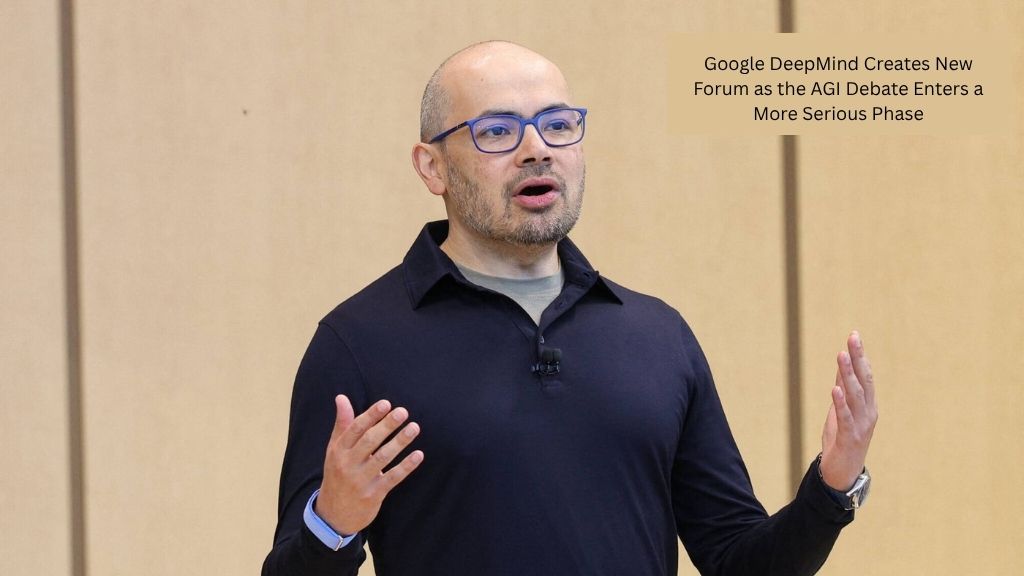
The DeepMind Institute, launched this week, is designed to bring together perspectives from Google, Google DeepMind and the wider research community. Its leadership includes DeepMind co-founder Shane Legg, Google executive James Manyika and Google DeepMind chair Demis Hassabis, with Legg serving as managing editor.
The institute’s stated premise is notable: participants will not necessarily agree with one another and may change their positions as new evidence emerges. That positions the initiative less as a corporate declaration about AGI and more as an attempt to create a forum for competing ideas around one of the technology industry’s most consequential developments.
For years, discussions around artificial general intelligence largely focused on technical progress and the question of whether machines could eventually match or exceed humans across a broad range of cognitive tasks.
The latest debate is becoming more practical.
The institute’s first collection contains four essays covering economic policy in response to potential AGI disruption, the transparency of AI reasoning, principles for human flourishing and methods for evaluating frontier AI models.
Together, the topics point toward an emerging priority for the industry: how to build institutions capable of assessing technologies that are advancing faster than existing governance frameworks.
The Transparency Problem
One of the institute’s essays, written by DeepMind safety researchers Rohin Shah and Anca Dragan, examines an increasingly important technical challenge: whether humans will continue to be able to understand and monitor how advanced AI systems reach their conclusions.
As AI architectures become more sophisticated, their internal reasoning can become harder to inspect. The researchers argue that reduced transparency should not simply be accepted as an unavoidable consequence of progress.
They suggest that developers and regulators may need to confront the trade-offs directly, potentially including limits on how much sequential computation a model can perform without producing a readable reasoning trace—or requiring developers to demonstrate that less transparent systems remain adequately monitorable.
For businesses deploying increasingly autonomous AI systems, the issue has direct implications. An AI model that can perform complex tasks but cannot be effectively evaluated introduces a different category of operational and regulatory risk.
Hassabis takes the discussion further in another essay, proposing a U.S.-led standards body capable of evaluating the world’s most advanced AI models.
Under the proposed framework, developers would initially submit frontier models voluntarily for assessment before release. Over time, successful evaluation could potentially become a requirement for deploying the most advanced systems in the United States.
The proposed evaluations would eventually include independent “held-out” tests, designed to prevent AI developers from optimizing models specifically for known benchmarks.
That would represent a significant change in how frontier AI could be assessed: from largely company-controlled testing toward a system involving greater external scrutiny.
The significance of the DeepMind Institute extends beyond the AGI research community.
If advanced AI systems become increasingly important to finance, healthcare, manufacturing, education.