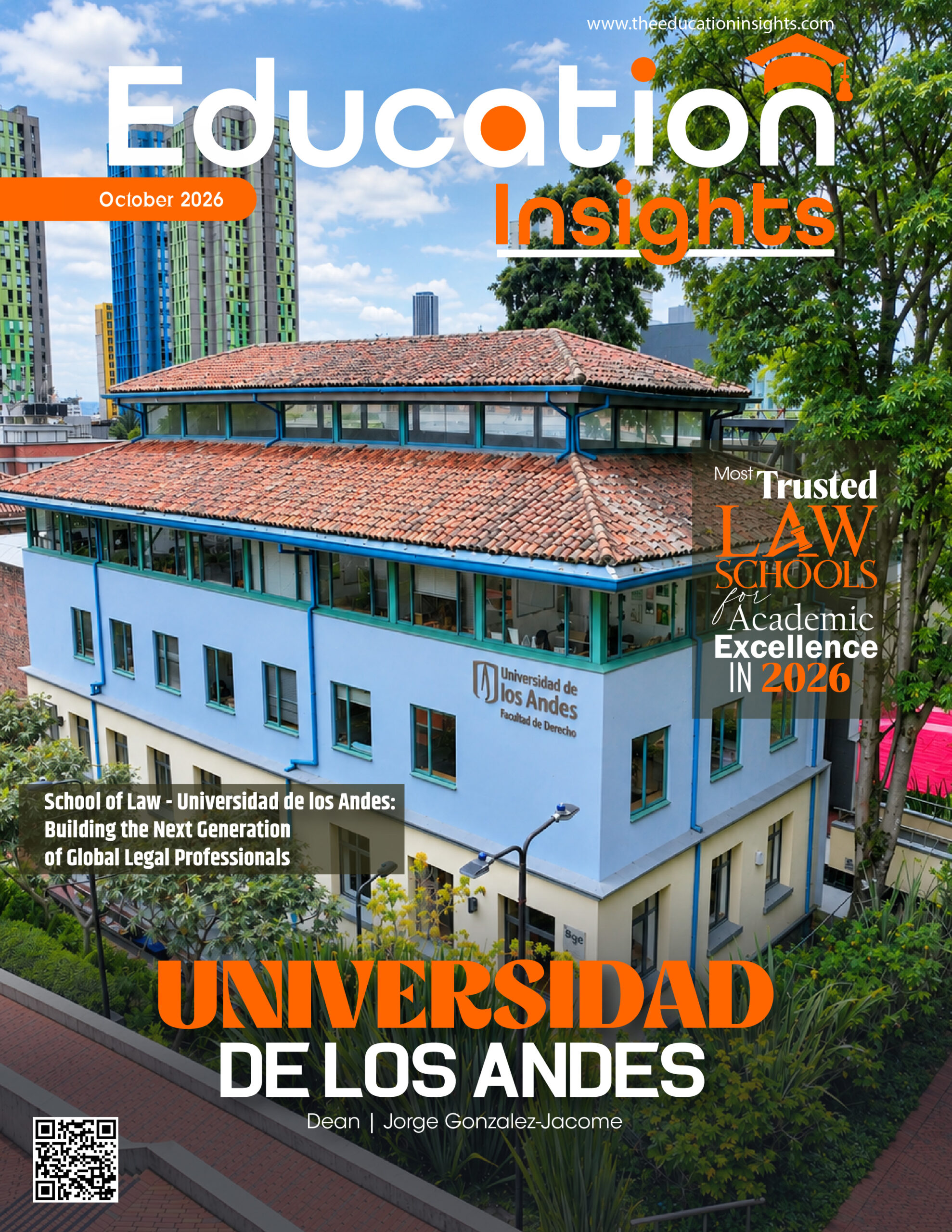

Located in Bogotá, Colombia, the Law School of Universidad de los Andes has spent nearly six decades building a distinctive model of legal education shaped by academic excellence, pedagogical innovation, and social responsibility. Established in 1968, two decades after the founding of the university itself, the Law School was created with a clear purpose: to promote secular, high-quality education and research while contributing meaningfully to the transformation of Colombian society.
Pedagogical innovation has been part of the law school’s DNA since the beginning, and over the years it has embraced various active-learning methodologies including problem-based learning, project-based learning, and, in its most recent undergraduate curriculum reform, a commitment to experiential learning. That’s nearly sixty years of sustained commitment, and it’s one of the things that really sets Universidad de los Andes apart from other law programs in Latin America.
Behind this lies an equally deliberate investment in faculty. Over the years, the Law School has built a diverse and interdisciplinary academic community of full-time professors dedicated to both teaching and research, with doctoral training from leading universities around the world.
“We see legal education itself as a way of practicing law, so when we bring on professors, we’re not just looking for experts in each field: we’re looking for people whose primary calling is teaching law. We don’t hire prestigious lawyers simply because they’re prestigious; we hire academics who want to build their life’s work around legal education,” explains Jorge González-Jácome, Dean at the School of Law of the Universidad de los Andes.
This philosophy naturally connects to the Law School’s third priority: renewal of legal scholarship. Faculty members, alongside master’s and PhD students, are encouraged to challenge conventional approaches and introduce new perspectives for understanding and critiquing the law. Beyond publishing in journals around the world, the Law School has developed its own in-house publication series, aimed at making a real impact across different areas of law, placing legal thinking in dialogue with other disciplines and helping imagine more just and solidarity-driven solutions to the problems law has always tried to solve.
Balancing Strong Theoretical Foundation and Practical Training
The Law School’s commitment to pedagogical innovation is grounded in an equally deep and ongoing conversation about the theoretical foundations of law itself. At the heart of this approach is a simple conviction: legal theory cannot be separated from legal practice. For the Law School, the kind of theoretical conversation that matters is the one that can analyze, explain, and critique legal practice and not the one that lingers above it. These theoretical discussions have real power to shape how law is practiced because they help the faculty train lawyers with a critical sense of their own profession who aren’t just equipped to work within the existing rules, but who can imagine and offer alternatives for change.
The Arrival of AI
Due to the arrival of AI into the legal profession, the Law School has focused on how legal training should revolve around building a set of competences and skills that will help future lawyers address the rapidly changing realities of their profession. Clinics, research, and experiential learning help the faculty develop the six main competences that they pursue in legal education: legal reasoning, conflict management, research, ethical citizenry, interdisciplinarity, and global and intercultural vision. Hence, the legal clinic model has students spend a significant amount of time providing supervised legal assistance to vulnerable populations, translating classroom learning into real accountability for real clients, while instilling the ethical grounding and service orientation the faculty considers central to its mission. Additionally, research projects, carried out alongside a research-active faculty, train students to think critically and contribute to legal scholarship rather than simply absorb it. This builds the analytical rigor that later shows up in strong academic and professional tasks. Finally, experiential, competency-based learning more broadly ensures students build practical skills like negotiation, argumentation, and problem-solving throughout their training. Together, these three elements produce graduates who are both intellectually rigorous and immediately effective in practice, which is reflected in the faculty’s strong employability outcomes and its standing as one of the region’s leading law schools.
“There are several opportunities for students to participate in different international collaborations. The University at large, and the Law School in particular, have a strong commitment to encouraging students to spend semesters abroad in institutions around the world with whom we’ve had strong relationships through the years,” says Jorge González-Jácome. “Likewise, every year we select students to participate in international law moot courts. We also have a Summer School where experts from around the world teach courses at Los Andes that undergraduate and graduate students can take for credit. The experience of learning from professors from other parts of the world has also deepened our commitment to place our law school in the global arena.”
The Transnationalization of Law Practice
Over the last three decades, economic and social globalization has led to the transnationalization of law practice. Nowadays, law schools need to balance the importance of training students for successful practice in their domestic jurisdictions with the demands of contemporary global processes and problems that lawyers are called to solve. Comparative legal perspectives are important for law students as they can build skills allowing them to understand, negotiate, respect, and deal with cultural differences.
Strengthening the Role of Legal Clinics
The Law School’s new curriculum, with its strong emphasis on experiential learning, has further strengthened the role of legal clinics. This commitment is equally evident in the faculty’s research agenda. The School places a strong emphasis on scholarship with social relevance, encouraging research that addresses some of the most complex legal and societal challenges of our time. Its publications will continue to explore areas such as environmental justice, gender inequality, technology and the administration of justice, transitional justice, the socialization of private law, law and political economy from Global South perspectives, and prison conditions.
“We envision our law school as a leading institution, especially in the Latin American context, where we will try to deepen our collaboration with our peers from the region through different academic networks. Leading through collaboration is our main goal,” explains Jorge González-Jácome.
Educating the Next Generation of Legal Professionals
The University of the Andes is uniquely positioned to educate a new generation of globally minded legal professionals by bringing international fluency together with deep local grounding. As legal problems increasingly cross borders, requiring lawyers to move confidently between jurisdictions, legal systems, and cultures, the Law School seeks to prepare its students for this reality by developing the competencies and practical skills needed to navigate an increasingly interconnected legal landscape. The objective is not simply to train lawyers for a single domestic jurisdiction, but to equip them with the adaptability to engage with unfamiliar legal environments and perspectives. Competence and skills are the key to achieving this goal. Likewise, legal clinics, which expose students to work with real consequences for real people, cultivate judgment and ethical seriousness that classroom instruction alone cannot provide. Additionally, international opportunities allow students to test their reasoning against unfamiliar legal traditions, building the adaptability that global practice demands. Taken together, these elements suggest a role for the university as a genuine hub where Latin American legal thought contributes actively to global conversations by producing graduates who bring a distinctive regional perspective to global scenarios rather than simply adapting to frameworks designed elsewhere. That combination of rootedness and range may be the university’s most valuable contribution to legal education going forward.