

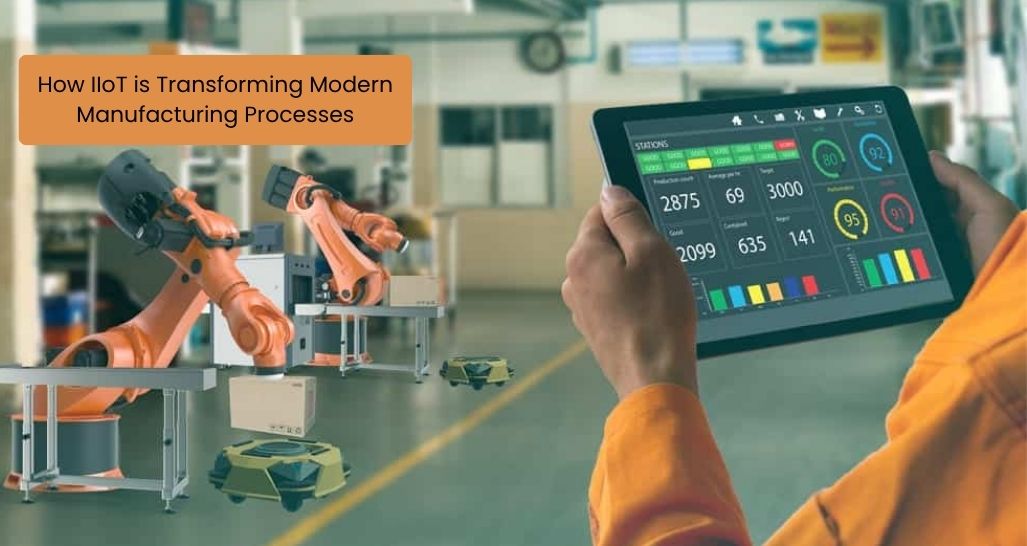
The Industrial Internet of Things (IIoT) is changing the manufacturing sector in an immense way. IIoT has become an important tool for innovation as companies move toward smarter and more efficient ways of doing business. IIoT is changing the traditional production methods by connecting machines, systems, and people through advanced networks. This is starting a new era of digital transformation in the industry.
Understanding IIoT in Manufacturing
Using sensors, devices, and software in industrial settings to collect and share data in real time is what the Industrial Internet of Things (IIoT) refers to. These interconnected systems allow manufacturers to monitor operations, evaluate performance, and make decisions based on data. In addition, they can keep a watch on performance. With the Internet of Things (IoT), connected machines create a single network that enhances communication and efficiency. This contrasts with traditional production, which often makes use of isolated systems. As a result of this connection, manufacturing shifts from a reactive paradigm, in which issues are fixed after they have occurred, to a proactive approach, in which problems are foreseen and avoided.
The Emergence of Smart Factory Technology
Smart industrial technology is one of the most significant results that has resulted from the Industrial Internet of Things (IIoT). It is possible to define smart factories as environments that are highly automated and digitally integrated, and in which machines and systems collaborate in an intelligent manner. Optimisation of production processes is achieved by these factories by the utilisation of real-time data, artificial intelligence, and advanced analytics.
Machines in a smart factory can communicate with one another, automatically adapt activities, and even learn from their previous performance. Therefore, this leads to increased production, decreased waste, and enhanced utilisation of available resources. Manufacturing companies are also able to respond more swiftly to shifting market demands thanks to the technology of smart factories, which also makes manufacturing more flexible and efficient.
Advancing Automation in Manufacturing
Manufacturing automation has been around for decades, but the Industrial Internet of Things has pushed it to a whole new level. In contrast to automation that is facilitated by the Internet of Things (IoT), which focuses on repetitive operations, traditional automation incorporates intelligence and adaptability into the system.
Now that IIoT is here, robots are no longer merely programmed tools; they can now analyse data and make judgements. For example, equipment can change its speed or how it works dependent on the conditions at the time, making sure it always works at its best. This amount of automation cuts down on the need for people to get involved, cuts down on mistakes, and makes everything work better.
Key IIoT Applications in Manufacturing
There are several key IIoT applications in manufacturing that are changing how industries work:
Predictive Maintenance
The Internet of Things makes it feasible to perform predictive maintenance by continuously monitoring the health of machines. Sensors allow maintenance staff to correct problems before they result in costly breakdowns by identifying wear or malfunction early on. This allows them to prevent costly breakdowns. The equipment’s lifespan is increased as a result, and the amount of downtime is reduced.
Real-Time Monitoring and Analytics
Live data on manufacturing processes, machine performance, and output quality are all available to manufacturers; they can access this data. Having visibility in real time enables individuals to make decisions more quickly and improves the efficiency of operations.
Supply Chain Optimization
A continuous flow of information is created because of the IIoT’s ability to connect the various phases of the supply chain. This results in an improvement in inventory management, a reduction in delays, and an enhancement of production coordination between manufacturers and suppliers.
Quality Control
Automated inspection systems that are powered by the Internet of Things ensure that product quality is consistent. The early detection of problems and the implementation of corrective actions are both possible for manufacturers who analyse production data.
Asset Tracking
The Industrial Internet of Things enables the tracking of supplies, tools, and equipment in real time within a plant. Because of this, resource management is improved, and losses are decreased.
Connected Machines and Data-Driven Operations
One of the characteristics that distinguishes the Industrial Internet of Things is the utilisation of connected machines and IIoT systems. A highly integrated production environment is created because of this equipment communicating with one another as well as with controlled systems located in the central location.
The data that is produced by these interconnected systems is an extremely important factor in the decision-making process. With the help of advanced analytics, manufacturers can analyse patterns, forecast demand, and improve workflow conditions. The digital transformation industry is characterised by a significant movement toward operations that are driven by data or information.
Enhancing Efficiency and Productivity
IIoT makes manufacturing operations a lot more efficient. Automated systems run all the time with very little downtime, which makes sure that they always produce the same results. Real-time monitoring makes it easier to find and fix problems quickly, which keeps everything running smoothly.
Also, IIoT makes it possible to have flexible manufacturing systems. It’s easy to rearrange production lines to make room for new items or changes in demand. In today’s fast-paced market, this flexibility to change is quite important.
Driving Digital Transformation in Industry
The digital transformation industry is built on IIoT. It lets manufacturers digitise their work, use more innovative technology, and make their business models more flexible. Cloud computing, edge computing, and artificial intelligence are some of the technologies that combine with IIoT to handle vast amounts of data and come up with useful insights. This integration makes things clearer, helps people make better decisions, and encourages new ideas.
Also, IIoT helps with efforts to be more environmentally friendly. Manufacturers may reduce their influence on the environment while still being efficient by using less energy and throwing away less.
Challenges and Future Outlook
There are problems with implementing IIoT, even if it has many benefits. Cybersecurity is still a big worry because connected systems can be hacked and have their data stolen. High initial costs and the necessity for experienced workers might also be problems.
The future of IIoT in manufacturing, on the other hand, seems quite bright. As technologies like 5G, AI, and digital twins continue to improve, IIoT systems will become increasingly more powerful. These new ideas will make automation, connection, and efficiency even better.
Conclusion
IIoT is changing modern production by making smart factory technologies possible, speeding up automation in manufacturing, and encouraging the growth of IIoT ecosystems with connected machines. It is an important part of the digital transformation business since it may give real-time insights, make things more efficient, and assist new ideas.
As more manufacturers use IIoT in their factories, the industry will keep moving toward production systems that are smarter, more efficient, and more connected. This change not only makes the company more competitive, but it also sets the stage for the future of production around the world.